Copyright Notice: This article is Copyright AI Factory Ltd. Re-use of it may be used with the direct permission of AI Factory Ltd.
All developers that publish on the Google Play and iOS stores need to handle user reviews. In many cases, this is a benign task, answering queries and responding to disquiet.
However, this is not always that simple. In our case, we have a Backgammon program, and it has always been the norm, from the beginning of time, for all Backgammon programs to be accused of cheating. How you handle this is important! These are our methods.
(Click on images to view a larger version.)
What can you do?
The vital key here is your public response. Some 10 years ago or so, I attended a Google Play Day session in central London. At the end of the session, Google asked people to put their hands up and make suggestions about how Google could best serve them. Various hands went up, points were made and notes were taken. I put my hand up and asked that the Google Console allow us to reply to reviews. To my surprise, a forest of hands immediately went up, with people enthusiastically saying, “Me too! Me too!”
Well, it did happen, and maybe this was the driver that made it happen. For sure, this was a profoundly important change that changed everything.
Which apps do people complain about?
Chess
The main drift is Backgammon, but we do get complaints for other apps, even Chess!
I have to quote one example from a while back:
“I know your program cheats because I am a very strong player and your program beat me”
That raised a smile. However, the vast bunk fall into two categories, which are just about the rules:
(1) Pawns disappearing after an opponent illegal pawn move.
This is, of course, En Passant and accounts for the majority of such complaints.
(2) Rooks jumping over the king.
This is, of course, castling and it is surprising how many players are simply unaware of the castling rule.
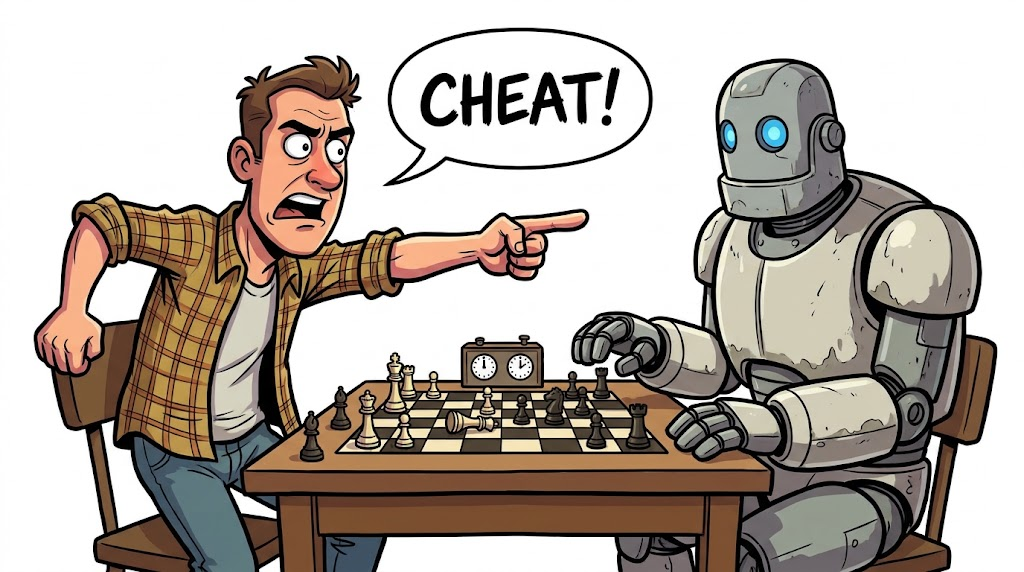
“Cheat!” – a familiar accusation, even in Chess
We also get complaints about the app stopping the king from passing through squares under attack, which simply reflects a misunderstanding of the rules. The rest are varied, unhinged assertions of cheating that have no logical basis.
We also get a small number of cheating accusations about Gin Rummy, Spades and Hearts, but not so many.
The big game, though, is Backgammon…
Backgammon
This is the reason why the article is being written at all. Backgammon suffers from an unfortunate characteristic for which there is no workaround, as follows:
A strong backgammon player may seem to be making suboptimal moves, but these plays are actually intended simply to maximise the chances of future progress and strengthen the defence. To another player, the strong player appears to be unreasonably lucky as a result, but it was actually just good play.
This phenomenon becomes acute in good computer play. When top neural-net engines (bots like Extreme Gammon (XG), Snowie, or JellyFish) evaluate a position, human observers often see a move that looks reckless, unnecessarily complicated, or “inferior” by traditional human standards. Then, over the next turn or two, the bot gets precisely the roll it needs, dodges danger, or punishes the opponent, prompting the human to complain: “The bot just rolls whatever it wants!”
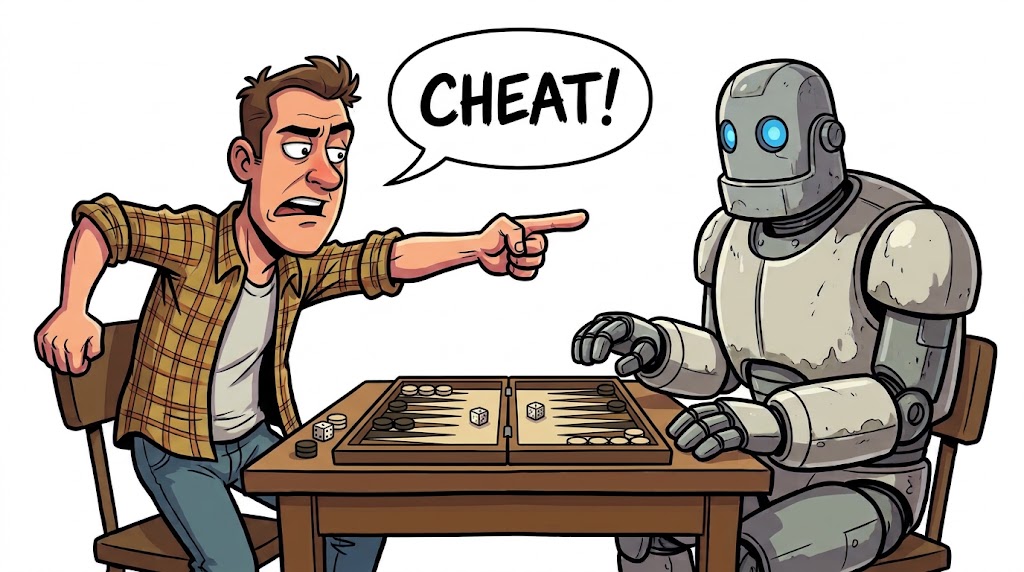
Backgammon: the game most often accused of cheating
This illusion boils down to how modern bots evaluate probability versus how humans intuitively evaluate safety.
This is not the only reason for perceived cheating. Others include:
(1) Apophenia - Human tendency to see patterns where there are no patterns
(2) Sampling perspective: With 200k players playing at any one time, some will inevitably see improbable dice rolls. A user who experiences this sees it as a unique event and applies flawed probability calculations to argue that it proves cheating. They then post a review, but users who saw normal dice rolls do not, resulting in reviews dominated by the few who saw “bad” rolls.
The end result is tens of thousands of angry reviews alleging cheating! This has even extended to death threats and, in one case, some 800 aggressive emails from just one player.
This is not new at all. If you step back into the archives to forums such as Backgammon galore, you can see that even a quarter of a century ago that Backgammon Cheating was a vexed issue that plagued programmers. This even pinged one programmer to post a humorous complaint form for users to fill in, when they saw cheating! This form is funny and worth a look!
Managing this Situation
You need a strategy to manage this. We have seen other developers address this issue and fail really badly. One particular developer responded very aggressively to such claims, and this just compounded the issue as people joined in to attack these “obvious liars”. This looked bad on the store, with reviews dominated by angry exchanges. It made everyone unhappy.
Our initial response
We responded to reviews but found little traction. We then tried various approaches:
(1) Explaining our background
In our replies we pointed out that we had published serious papers in AI, providing a link to these, also pointing out that we had published much harder games that had succeeded well in international competition, so why cheat at Backgammon?
This achieved very little. People dismissed that we had published anything and were angry that we denied cheating.
(2) Getting Gaming labs International (GLI) to test our program
This was a professional organisation whose sole job was to verify that software did not cheat, mainly for gambling apps. They built and tested our program, and we were the able to have a link to the report accessible in the app, and also in the review replies. This seemed a very promising idea.
Maybe this made some difference, but we still had streams of claims against us. People assumed that GLI were collaborating to falsify the result.
(3) Providing a detailed on-line web page that explained why it did not cheat.
This was a big step forward! … as suddenly we were not limited to just 350 characters to reply to reviews! Now we could explain everything. We detailed the top three reasons why games might be considered to have cheated. We provided every possible complaint in a FAQ section, with a repost to each claim. This was a big document. This did have an impact.
Measuring Success
It is not so easy to be sure how successful each strategy was, as you needed to vary your responses anyway, so you could not be sure which one had actually landed. However, we did have a means of gauging this through the thumbs up/down accompanying each review. In the early days, we might have bad reviews receiving up to 100 thumbs up, which was a disaster, as users would see that other people had agreed, and the review would float to the top of the “Most relevant” listing (the default).
In our early days, and from observing other backgammon programs, the norm was for the first 10 reviews listed to be mostly 1-star reviews with many thumbs up. After a period, we broke away from that, with almost all bad reviews getting no thumbs up/down at all and perhaps just two of the top 10 reviews alleging cheating.
Our Follow-on Analysis
We had made some progress with the above, but more was needed. After much built-up experience and testing ideas, we nailed down these key priorities:
(1) The players reading the review: The key target for your reply
The most important group is the people who read the review and the reply, not the reviewer. There may be tens of thousands of readers. You need a reply that is most likely to elicit a positive response from them. A key facet of this is that people who read the review may give it a thumbs up or thumbs down.
(2) The person that posted the review
You need the reviewer not to escalate, their point to be clearly countered, or their review to be taken down. This is a fine balance. If your response humiliates the reviewer, their review is likely to receive many thumbs up, as you will seem to have been too aggressive in responding to their “valid” point or naivety. Using gentle humour often works well. You have to judge the tone of the review before choosing your response.
(3) Avoid looking like the reply is a form response
Users will pick up on this. You need to look as if you have really responded to that review, not posted out a universal form response.
(4) Reply ASAP
This is necessary because you need to get in before lots of people give the review a thumbs up. Reviews with lots of responses get pushed up the “Most relevant” listing and therefore attract more eyeballs!
(5) Making the first 100 characters in the reply count
This is easily missed, but the Google Play app only shows about the first 100 characters of your reply unless the reader clicks on it, so those first 100 characters need to count and do a job on their own.
(6) Managing review response options
This may seem a small point, but you need a convenient way of organising a library of review replies. We have found that the most convenient way is to store them in a WhatsApp group so that you can easily copy and edit them. WhatsApp allows you to copy a reply in one click, without needing to select a section of text first. If you want a particular type of reply, you can search for a keyword, and WhatsApp will display a list of replies containing it. This is better than keeping replies in a text file, where matches may be scattered throughout the file, making them harder to compare.
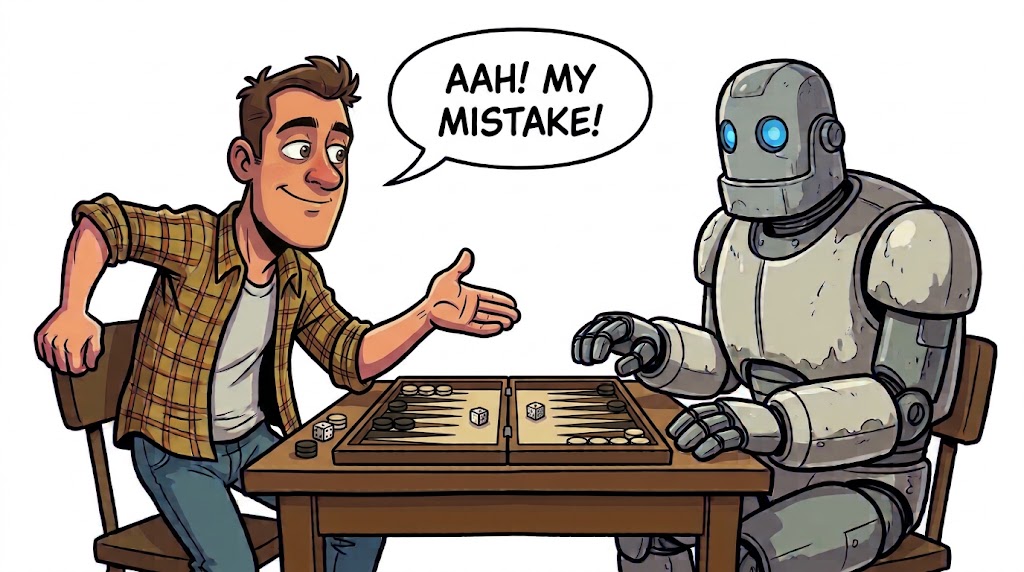
The goal: “Aah! My mistake!”
Delivering the “Win”
This may sound optimistic, but there is actually a way. We now have a collection of replies available to use as templates, which you can copy and edit as follows:
…………………………………. The dice are strictly fair. We use an industry-standard LCR RNG. Best you just run our definitive tests that prove no cheating at aifactory.co.uk/bg.htm, then you will know. Note: all Backgammon software is accused of cheating. Really? No.
This has a leading unused section, where you can add a comment that links to the review, e.g.
An interesting idea, but not true. The dice are strictly fair. We use an industry-standard LCR RNG. Best you just run our definitive tests that prove no cheating at aifactory.co.uk/bg.htm, then you will know. Note: all Backgammon software is accused of cheating. Really? No.
Now it does not look like a form response and is linked to the review. Maybe there is no hook in there for a personalised response, so you need a library of responses that fit the 350 character reply limit.
Immediate denial:
Not rigged. The dice are strictly fair, it’s just strong. We use an industry-standard LCR RNG. Just run our definitive tests that prove no cheating at aifactory.co.uk/bg.htm. Remember all Backgammon software is accused of cheating. Really? No.
Sympathetic:
Sorry but that is an illusion. We use an industry-standard LCR RNG used throughout gaming industry. Just run our definitive tests that prove no cheating at aifactory.co.uk/bg.htm. Remember all Backgammon software is accused of cheating. Really? No.
Logic:
We have no reason to do this. We wrote the program and know it does not cheat! The dice use a standard LCG random number generator. We provide clear tests proving there is no cheating: aifactory.co.uk/bg.htm. Astonishingly, all backgammon programs are accused of cheating. Is it true? No.
Proof up front:
Run our definitive tests proving fair dice at aifactory.co.uk/bg.htm. Its 100% fair. We use an industry-standard LCR RNG. We wrote it so know it plays fair. Note: Absolutely all backgammon software is accused of using dodgy dice. Really? I'm afraid not.
And finally, the win!
This is the strongest Backgammon on Google Play. Just run our definitive tests that prove no cheating at aifactory.co.uk/bg.htm. Remember all Backgammon software is accused of cheating. Really? No.
This last example is the win. The review may be so full of abuse that no response could quash the point being made, so you can sidestep it and take the opportunity to advertise that the game is the strongest on Google Play, which you are not allowed to do in the product description! The reviewer has offered you a free extra billboard where you can claim what you cannot claim in the store listing!
Jeff Rollason - 23 Oct 2026